VR Boxing Game
A compact case study covering the problem, solution, UX research, design decisions, and development outcomes for an interactive VR boxing experience.
← Back to Projects
Overview
ActiveStrike is a motion-driven boxing experience concept focused on making active gameplay feel accessible, intuitive, and enjoyable. The project explores how motion input can be designed for different mobility ranges through calibration, sensitivity tuning, and inclusive interaction design—so players can stay engaged physically without sacrificing comfort, control, or ease of use.
Role:
UX/UI, interaction design, prototyping, testing support, and iteration.
Tools:
- Figma
- Unity / XR Toolkit
- User testing notes
- Iteration + feedback loops
- Documentation
Problem
Motion-based games exist, but many still assume a “full-range” player—standing, fast reactions, wide arm movement—and that unintentionally excludes people with limited mobility or lower endurance. At the same time, traditional gaming is largely sedentary, which reduces physical engagement during long play sessions. This creates a design gap: players want more active, immersive gameplay, but they need it to be comfortable, adaptable, and inclusive rather than physically demanding by default.
Solution
ActiveStrike proposes an adaptive motion-input approach where boxing interactions are mapped to intent-based gestures instead of demanding full athletic movement. Players can calibrate their comfortable range of motion, adjust sensitivity for intensity, and use accessibility-friendly mappings (e.g., seated mode, gesture smoothing, reduced movement requirements). The result is a motion experience that feels physically engaging while staying easy to learn, fatigue-aware, and playable across different abilities.
UX Research
This concept started with early discovery research to validate one core question: can motion-driven play make gaming more active and inclusive—without sacrificing comfort, control, or enjoyment? I combined rapid desk research with a small round of exploratory feedback to identify what matters most for accessibility, engagement, and long-session usability.
Research goals
- Understand the real-world problem motion-based gameplay is trying to solve (health + accessibility).
- Identify who benefits most, and what “accessible motion” needs to feel like in practice.
- Define the minimum requirements for a motion-controlled experience to be meaningfully different from a standard controller.
- Pressure-test early interaction ideas before committing to a full prototype build.
Key discovery questions
- What barriers stop players (especially gamers with physical limitations) from engaging with motion-heavy games?
- What motions feel realistic, enjoyable, and sustainable for repeat play?
- How do we avoid “novelty motion” (wrist flicks) and instead encourage full, intentional movement?
- What feedback (visual/audio/haptic) is required so players feel in control and confident?
Early feedback insights
- Movement needs to feel “whole-body,” not just arms/wrists. Players wanted more torso rotation and shoulder/chest engagement so the game feels physical and intentional.
- More variety = more value. Feedback suggested expanding beyond 3–4 repeated gestures and introducing a wider range of movements for depth and replayability.
- It must clearly outperform a normal controller. If the motion mapping feels too similar to traditional input, the experience loses its purpose—motion must add meaning, not friction.
- Consider modular experiences. One strong direction was designing modes that focus on different movement groups (arms, shoulders, torso), allowing players to choose what suits their ability and stamina.
Research-driven design requirements
- Accessible calibration: quick setup and adjustable motion range (so different abilities can play comfortably).
- Adjustable intensity: light-to-active modes so sessions can be safe, repeatable, and inclusive.
- Clear interaction feedback: visible confirmation that punches/blocks/dodges registered correctly.
- Comfort-first interaction design: reduce strain during longer play and avoid repetitive high-stress motions.
- Meaningful motion mapping: movement should drive outcomes in a way that feels intuitive and rewarding.
How I planned to evaluate the prototype
- Comparative testing: play the same experience with motion input vs. a traditional controller to assess engagement and movement.
- Task-based walkthrough: scripted actions (punch, block, dodge, reposition) to validate learnability and control.
- Success criteria: players report higher engagement and noticeable movement increase, without a drop in comfort or control.
Design
Design focused on one thing: turning “motion boxing” into an interaction system that feels intuitive, readable, and accessible. Instead of designing for maximum athletic movement, I built a gesture set around clear intent (punch, guard, grab, move) and then shaped the experience with feedback, comfort constraints, and repeatable action loops.
Interaction model
I designed the core gameplay as a small set of repeatable combat actions, each mapped to a distinct motion pattern. The goal was to keep inputs easy to learn, reduce accidental triggers, and make the player feel physically involved without forcing high-intensity movement.
- Intent-based gestures: actions are triggered by purposeful movement patterns (not tiny wrist flicks).
- Two-hand control vocabulary: designed around symmetry for clarity (e.g., guard = both hands).
- Comfort-first ranges: gestures can be performed in smaller arcs while still reading as “boxing.”
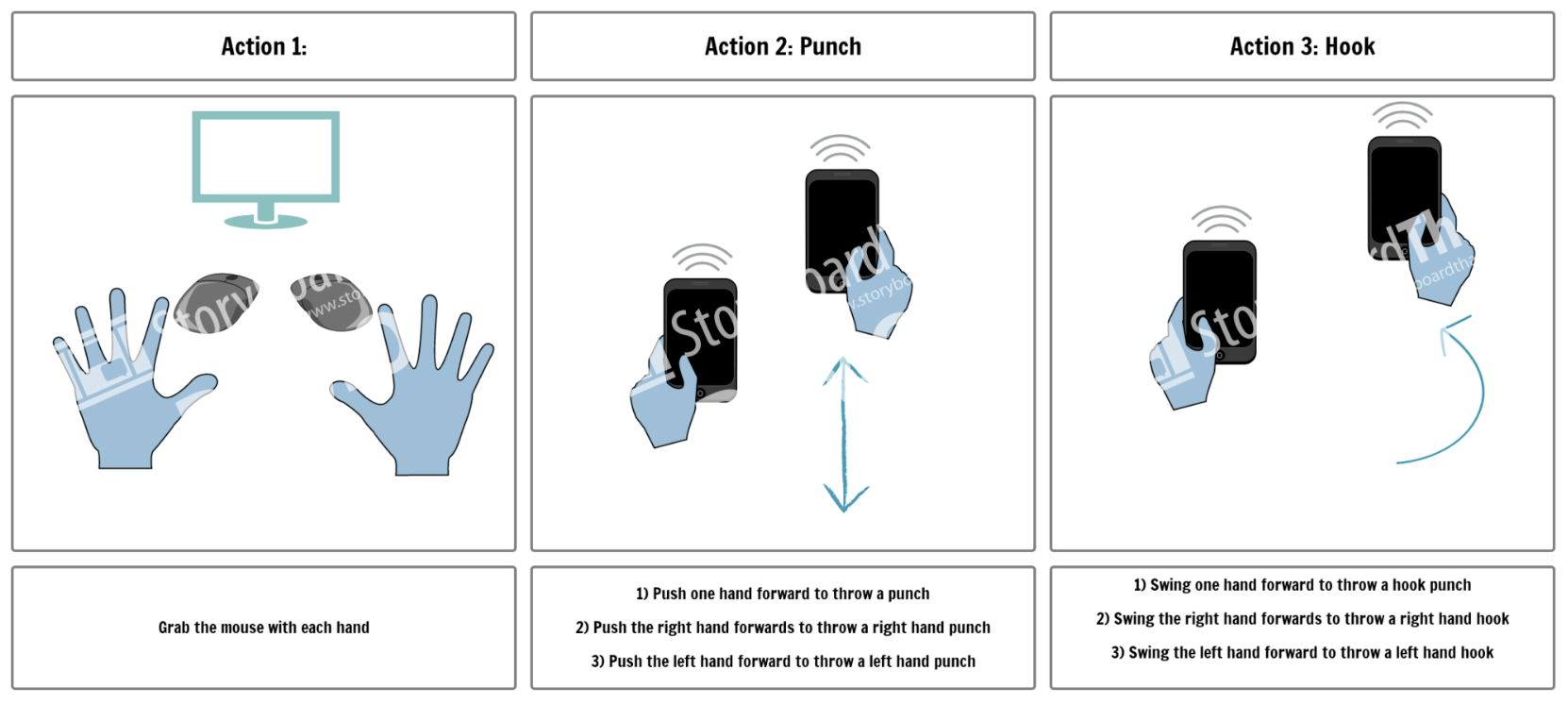
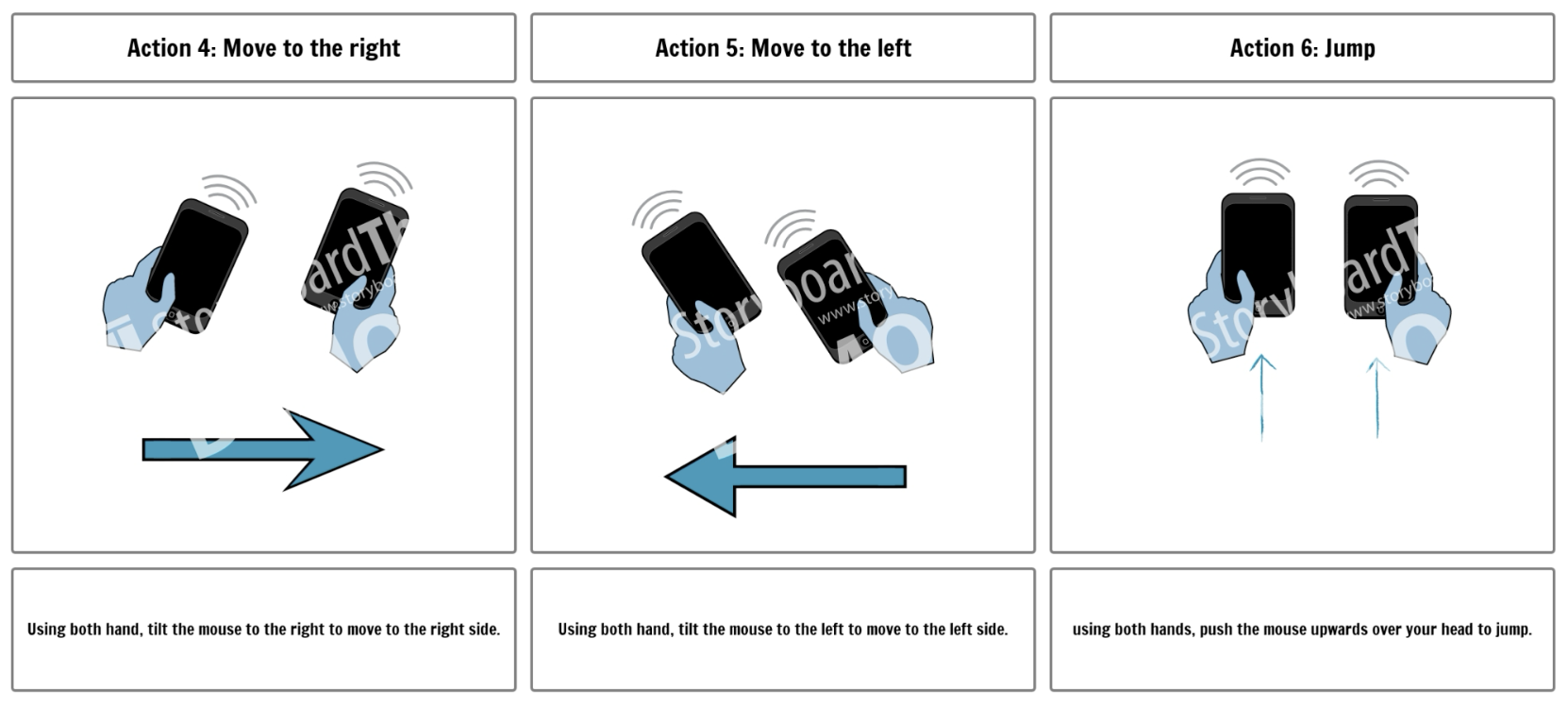
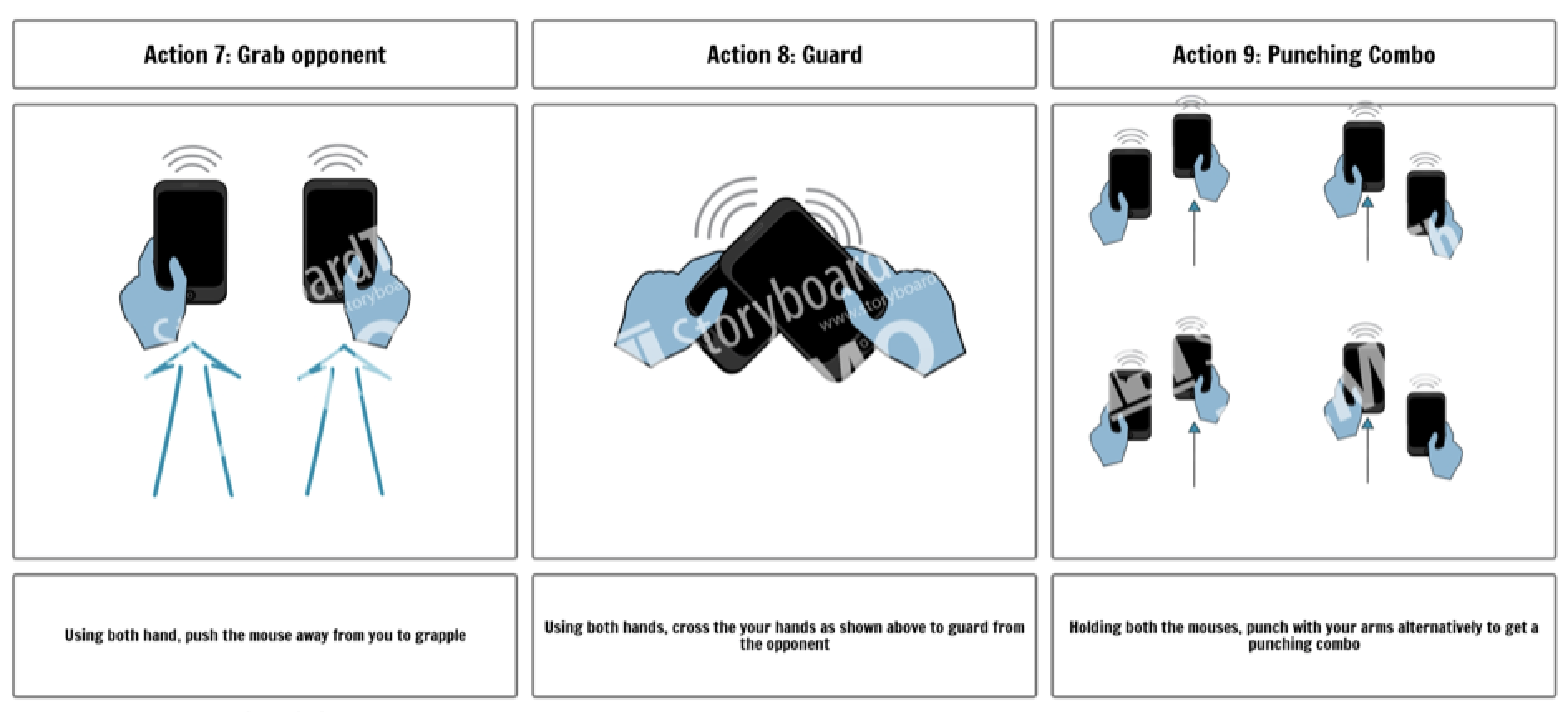
Storyboarded gesture set
I storyboarded the full interaction set before building, so I could sanity-check learnability and sequencing. This also made it easier to test whether the controls felt consistent across movement, combat, and defensive actions.
- Action 1 — Ready / Setup: establish both hands/controllers as the “boxing stance” baseline.
- Action 2 — Punch: forward strike motion designed to be readable and repeatable.
- Action 3 — Hook: curved swing gesture to create variety beyond straight punches.
- Action 4–5 — Lateral movement: two-hand tilt/shift to move left or right without complex locomotion.
- Action 6 — Jump: upward two-hand motion to trigger a quick reposition/evade moment.
- Action 7 — Grab opponent: forward push gesture to represent a grapple/close-range interaction.
- Action 8 — Guard: crossing both hands to form a clear defensive “block” state.
- Action 9 — Punching combo: alternating punches to create rhythm and a satisfying skill loop.
Feedback & Clarity
Motion controls only work when players trust what the system “understood.” I designed feedback to confirm successful actions quickly and reduce uncertainty during fast sequences—especially for guard and combo timing where missed recognition feels unfair.
- Immediate confirmation: every action needs a clear “registered” response (visual/audio/haptic as available).
- Error tolerance: smoothing helps prevent accidental triggers from micro-movements.
- Fatigue-aware design: gestures are designed to be repeatable without high strain.
Prototype artifact
I supported the design with a short interaction prototype video to demonstrate timing, readability, and the overall flow of actions during play. This helped validate whether the gesture set felt coherent as a “system,” not just isolated inputs.
Development
I built ActiveStrike as a Unity prototype to prove one thing: boxing can feel satisfying with motion-led inputs while still being readable and controllable. The focus in development was getting the “game feel” right—tight input, clear animation feedback, and an opponent that creates pressure without becoming unfair.
Build setup
The project was assembled as a clean Unity package with the standard Unity structure (Assets / Packages / ProjectSettings) so it could be opened and reviewed easily. I also exported a .unitypackage for submission/hand-off and recorded short gameplay clips to document progress.
What I implemented
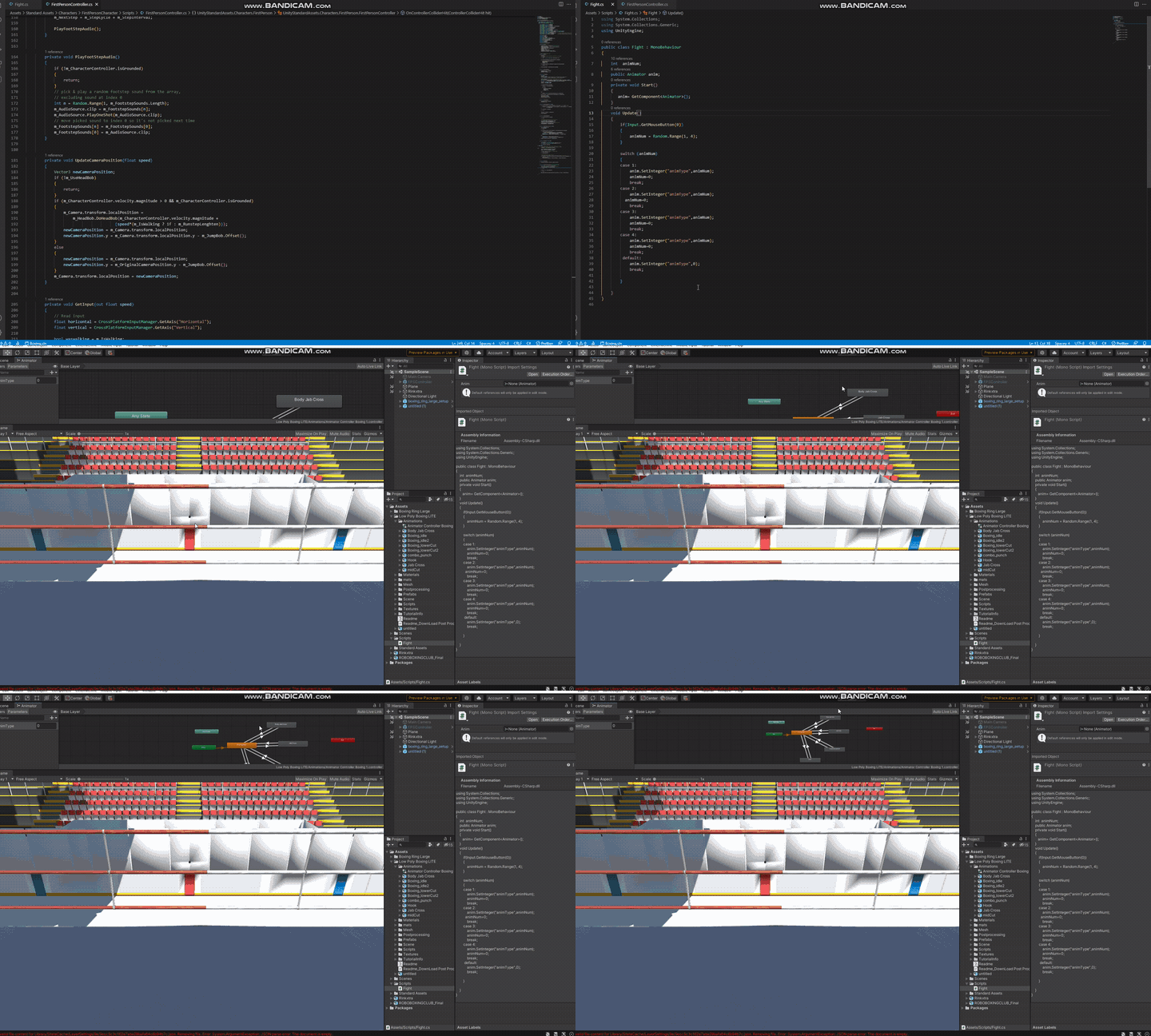
- Core combat loop: punch inputs triggering punch variations through the Animator (kept fast and responsive).
- Opponent pressure: a simple enemy chase behaviour using NavMeshAgent so the player is forced to react and reposition.
- Interaction coverage: I translated the designed action set into implementable behaviours—punch, hook, move left/right, jump, guard, grab, and combo intent.
- Playtest-ready demo flow: a lightweight build that demonstrates the idea quickly without extra menus or friction.
Prototype in Action
Short capture from the Unity prototype showing core movement + boxing interactions during development.
Code highlights
I kept the code small and purposeful—enough to prove the mechanics without over-engineering the prototype. Two short snippets below: one for combat input → animation, and one for enemy behaviour.
// simplified from Fight.cs
            if (Input.GetKeyDown(KeyCode.Mouse0)) {
                int action = Random.Range(1, 6); // int max is exclusive → 1–5

                if (action == 1) anim.SetTrigger("Punch1");
                if (action == 2) anim.SetTrigger("Punch2");
                if (action == 3) anim.SetTrigger("Punch3");
                if (action == 4) anim.SetTrigger("Punch4");
                if (action == 5) anim.SetTrigger("Punch5");
}// simplified from Enemy.cs
agent = GetComponent<NavMeshAgent>();
player = GameObject.FindGameObjectWithTag("Player").transform;
void Update() {
agent.SetDestination(player.position);
if (Vector3.Distance(transform.position, player.position) < chaseDistance) {
anim.SetBool("IsWalking", true);
} else {
anim.SetBool("IsWalking", false);
}
}What I’d improve next
- Readable hit confirmation: clearer feedback when punches land (audio/haptic/impact VFX) so the loop feels more rewarding.
- Less “random punch”: replace randomness with a small combo-state system so actions feel intentional and skill-based.
- More opponent variety: add simple behaviours (guarding, step-back, counter) so the prototype better demonstrates depth.