Executive Summary
This paper critically analyses Aqualumia, a physical computing installation that blends exploration and play to create an interactive marine environment. Users manipulate fish and seaweed models through embodied tools (a trident and lamp), transforming learning into an active experience where curiosity, movement, and collaboration are central. The project demonstrates how playful interaction can increase engagement while delivering conservation-oriented learning outcomes.
Findings show the experience resonated across demographics—driving curiosity in younger participants and nostalgia and reflection in older audiences—suggesting strong potential for public-facing educational installations. A key technical limitation was variable ambient light disrupting LDR sensor detection; future improvements should prioritise calibration and robustness in real-world conditions, and strengthen learning scaffolds to improve clarity and retention.
Key Highlights
What this demonstrates (professionally)
- Designing for attention: Converts passive information into active exploration—useful for museum exhibits, public engagement, and learning products.
- Embodied interaction design: Uses physical affordances (tools + sensors) to create meaningful system feedback and collaboration.
- Evaluation-driven iteration: Interprets feedback across demographics and translates it into clear technical + design improvements.
- Engineering constraints awareness: Identifies environmental reliability issues (lighting) early—critical for real deployments.
System Overview
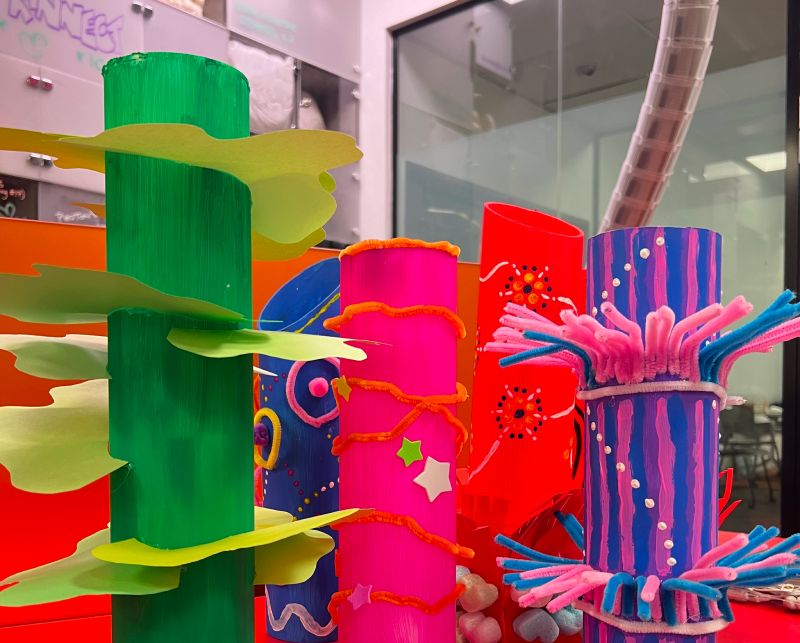
Aqualumia comprises four main components: fish models, seaweed, coral, and the lamp + trident. Fish and seaweed movement is driven by servo motors, while LDR sensors detect light from the interaction tools. Users guide fish toward coloured coral markers; when a coral colour is detected, motion pauses and an audio track plays with biodiversity and conservation information.
- Interactive control: Light-based triggering using handheld tools.
- Playful learning loop: Discovery → feedback → information delivery.
- Collaboration: Users naturally coordinate to explore and trigger events.
Constraints & Improvements
A core reliability issue occurred under bright ambient lighting, where LDR sensors struggled to detect the tool LEDs consistently. This reduced responsiveness and could weaken the perceived quality of the experience.
Recommended improvements
- Sensor calibration: Tune thresholds and shielding for variable lighting.
- Resilience: Add redundancy or alternative sensing to maintain responsiveness.
- Learning scaffolds: Make educational moments clearer and more structured for retention.
Download
If you’d like the full report, you can download it below.